
Table of Contents
- What Are PPR Pipes Made Of?
- What Is Polypropylene Random Copolymer (PPR)?
- How PPR Material Is Manufactured
- Key Properties of PPR Material
- Why PPR Is Used for Hot and Cold Water Plumbing
- Are PPR Pipes Safe for Drinking Water?
- How PPR Material Resists Corrosion and Chemical Damage
- PPR Material vs Other Plumbing Materials
- How to Identify High Quality PPR Pipes
- Common Myths About PPR Pipe Materials
- Why Material Quality Matters in Plumbing Systems
- Frequently Asked Questions (FAQs)
- Conclusion
- Why Choose TUFF PN25 PPR Pipes?
- Speak with a TUFF Plumbing Expert
What Is a PPR Pipe?
PPR pipe is manufactured from Polypropylene Random Copolymer, a thermoplastic material developed for pressurised plumbing systems. It is widely used for hot and cold water distribution because of its resistance to corrosion, mineral scale build up, and high operating temperatures.
One of the defining characteristics of PPR is its heat fusion welding installation method. During installation, the pipe and fitting are heated using a fusion welding machine and permanently fused together, creating a continuous joint of the same material. When installed correctly, this process produces durable, leak resistant connections suitable for long term plumbing performance.
PPR pipes are available in different pressure classes, including PN10, PN16, PN20, and PN25, allowing engineers and plumbers to select products that match the operating conditions of each project.
What Are PPR Pipes Made Of?
The performance of any plumbing system begins with the material from which it is made.
Whether a pipe is expected to carry hot water, withstand high pressure, resist corrosion, or provide safe drinking water, its long term reliability depends on the properties of the material itself. This is one of the main reasons PPR pipes have become a preferred choice for modern plumbing systems around the world.
PPR pipes are made from Polypropylene Random Copolymer (PPR), a high performance thermoplastic specifically engineered for pressurised hot and cold water distribution. The material combines strength, durability, chemical resistance, and thermal stability, making it suitable for a wide range of residential, commercial, healthcare, hospitality, and industrial plumbing applications.
Unlike traditional metal pipes, PPR does not rust or corrode when exposed to water. Unlike some piping materials that rely on adhesives or mechanical joints, PPR pipes are designed to be joined using heat fusion welding, creating durable, leak resistant connections that become an integral part of the plumbing system when installed correctly.
The unique characteristics of Polypropylene Random Copolymer also contribute to excellent resistance against scale build up, many chemicals commonly encountered in water distribution systems, and the effects of continuous water flow. These properties help maintain consistent system performance while reducing maintenance requirements over the life of the installation.
Another important advantage of PPR material is its suitability for potable water systems. High quality PPR pipes manufactured to recognised standards are designed for transporting drinking water without affecting water quality, making them a trusted choice for homes, hospitals, schools, hotels, and commercial buildings.
However, not all PPR pipes are manufactured to the same quality standards. The type of raw material used, manufacturing processes, pressure classification, and overall product quality all influence how well a plumbing system performs over time.
Understanding what PPR pipes are made of and why that material matters helps homeowners, plumbers, contractors, engineers, architects, consultants, and developers make informed decisions when selecting plumbing materials for new construction or renovation projects.
In this guide, we’ll explore the composition of PPR pipes, examine the properties of Polypropylene Random Copolymer, explain why it has become one of the world’s leading plumbing materials, and provide practical insights into choosing high-quality PPR systems for reliable, long term performance.

What Is Polypropylene Random Copolymer (PPR)?
The letters PPR stand for Polypropylene Random Copolymer, a high performance thermoplastic developed specifically for pressurised piping systems.
It belongs to the polypropylene family of plastics but is engineered with a modified molecular structure that improves its mechanical strength, flexibility, thermal stability, and long term resistance to pressure. These characteristics have made PPR one of the most widely used materials for hot and cold water plumbing systems around the world.
Unlike conventional plastics that may become brittle or unsuitable for continuous pressurised water distribution, Polypropylene Random Copolymer is designed to perform under demanding operating conditions while maintaining its structural integrity over many years.
Why Is It Called “Random Copolymer”?
The term “Random Copolymer” refers to the way different molecular units are arranged during the manufacturing process.
This random molecular structure improves several important material properties, including:
- Better impact resistance
- Improved flexibility
- Enhanced resistance to pressure
- Excellent thermal stability
- Greater durability under long-term service conditions
These characteristics make PPR particularly suitable for plumbing systems that carry both hot and cold water.
A Material Designed for Plumbing Applications
Polypropylene Random Copolymer is not simply another plastic.
It has been developed to meet the specific demands of modern plumbing systems, where pipes are expected to withstand continuous water pressure, temperature changes, and daily use while maintaining reliable performance.
Because of these properties, PPR is widely used in:
- Residential water supply systems
- Commercial buildings
- Hospitals and healthcare facilities
- Hotels and hospitality projects
- Schools and educational institutions
- Industrial water distribution systems
Its versatility has made it one of the most recognised piping materials in modern construction.
Why Polypropylene Random Copolymer Performs So Well
The success of PPR pipes comes from the balance of properties offered by the material itself.
Polypropylene Random Copolymer provides:
- High resistance to corrosion
- Excellent chemical resistance
- Low thermal conductivity
- Smooth internal surfaces that support efficient water flow
- Compatibility with heat fusion welding
- Long term durability under normal operating conditions
These properties work together to create plumbing systems that are reliable, efficient, and designed for extended service life.
More Than Just a Plastic Pipe
Understanding that PPR pipes are manufactured from Polypropylene Random Copolymer helps explain why they are trusted in modern plumbing.
Rather than relying solely on appearance or cost, professionals evaluate the material itself because it determines how well the pipe performs under pressure, responds to temperature changes, resists corrosion, and supports safe water distribution.
For homeowners, contractors, engineers, and developers alike, understanding the material behind PPR pipes is the first step toward selecting a plumbing system built for long term reliability.

How PPR Material Is Manufactured
The quality of a PPR plumbing system begins long before the pipes reach a construction site. It starts in the manufacturing process, where carefully selected raw materials are transformed into durable pipes and fittings designed for reliable hot and cold water distribution.
Every stage of production plays an important role in determining the strength, consistency, and long term performance of the finished product.
Step 1: Raw Material Selection
The manufacturing process begins with high quality Polypropylene Random Copolymer (PPR) resin.
The quality of this raw material has a direct impact on the finished pipe’s pressure performance, durability, and resistance to heat and chemicals. Manufacturers therefore use carefully controlled raw materials that are suitable for plumbing applications.
Using consistent, high quality resin helps ensure uniform product performance throughout the production process.
Step 2: Material Preparation
Before production begins, the PPR resin is prepared for processing.
The raw material is carefully handled to maintain consistency and may be blended with approved additives that enhance processing stability, colour, and long term product performance while maintaining the material’s suitability for potable water applications.
Quality control during this stage helps ensure that every production batch meets the required specifications.
Step 3: Extrusion
Once prepared, the PPR material is fed into an extrusion machine.
Inside the machine, the material is heated until it becomes workable and is then forced through a precision die that forms the pipe to its required diameter and wall thickness.
This continuous extrusion process allows manufacturers to produce pipes with consistent dimensions and smooth internal and external surfaces.
Step 4: Cooling and Calibration
After leaving the extrusion die, the newly formed pipe passes through a controlled cooling and calibration process.
This stage helps the pipe maintain its correct shape, dimensions, and wall thickness while preventing deformation during production.
Accurate calibration is essential for ensuring compatibility with matching PPR fittings and maintaining consistent pressure performance.
Step 5: Quality Inspection
Every batch of PPR pipes should undergo quality inspection before being approved for distribution.
Manufacturers typically verify characteristics such as:
- Pipe diameter
- Wall thickness
- Surface finish
- Pressure performance
- Dimensional accuracy
- Product markings
Quality inspection helps ensure that the finished pipes meet the manufacturer’s specifications and applicable industry standards.
Step 6: Cutting, Marking, and Packaging
After inspection, the pipes are cut to standard lengths, marked with important product information, and packaged for storage and transportation.
Typical product markings may include:
- Manufacturer’s name
- Pipe size
- Pressure class (PN rating)
- Production information
- Applicable standards
These markings help installers and project managers identify the correct product for each application.
Why Manufacturing Quality Matters
The manufacturing process has a direct influence on the reliability of a plumbing system.
Consistent raw materials, precision production equipment, strict quality control, and accurate product testing all contribute to pipes that perform reliably under normal operating conditions.
For homeowners, plumbers, contractors, engineers, and developers, choosing pipes from a manufacturer committed to quality provides greater confidence that the plumbing system has been produced to deliver dependable long term performance.
Key Properties of PPR Material
The widespread use of Polypropylene Random Copolymer (PPR) in modern plumbing is largely due to its unique combination of physical, mechanical, and chemical properties.
Rather than relying on a single advantage, PPR delivers balanced performance across several critical areas that influence the reliability, efficiency, and longevity of plumbing systems. These properties make it suitable for residential, commercial, healthcare, hospitality, and industrial water distribution applications.
1. Excellent Pressure Resistance
PPR is engineered to withstand continuous internal water pressure when installed and operated within its specified pressure class.
Available in pressure ratings such as PN10, PN16, PN20, and PN25, PPR pipes can be selected to match different plumbing requirements, helping ensure reliable performance under normal operating conditions.
2. High Thermal Stability
One of the most important characteristics of PPR is its ability to perform in both hot and cold water systems.
Its thermal stability allows it to maintain its structural integrity across a wide range of operating temperatures, making it suitable for domestic hot water supply, commercial plumbing, and central water distribution systems.
3. Corrosion Resistance
Unlike traditional metal pipes, PPR does not rust or corrode when exposed to water.
This resistance helps preserve water quality, reduces maintenance requirements, and eliminates many of the problems associated with corrosion in metallic piping systems.
4. Chemical Resistance
PPR offers excellent resistance to many chemicals commonly encountered in plumbing and water distribution systems.
This property helps protect the pipe material from chemical degradation and contributes to dependable long-term performance when used within its intended applications.
5. Smooth Internal Surface
PPR pipes have a smooth internal bore that promotes efficient water flow.
The smooth surface helps reduce friction losses and makes the pipe less likely to accumulate mineral deposits compared with some traditional piping materials.
Maintaining efficient flow contributes to the overall performance of the plumbing system throughout its service life.
6. Heat Fusion Compatibility
Unlike piping systems that depend on adhesives or threaded joints, PPR is specifically designed for heat fusion welding.
This joining method allows the pipe and fitting to become a continuous connection when installed correctly, producing durable, leak resistant joints suitable for pressurised plumbing systems.
7. Lightweight Yet Durable
Despite its strength, PPR remains relatively lightweight compared with many traditional plumbing materials.
Its lighter weight simplifies transportation, handling, and installation while maintaining the durability required for demanding plumbing applications.
8. Long-Term Performance
When manufactured to recognised quality standards, correctly installed, and used within the manufacturer’s recommended operating conditions, PPR plumbing systems are designed to provide dependable long term service.
Their combination of pressure resistance, corrosion resistance, thermal stability, and durable fusion joints has contributed to their widespread adoption in modern construction projects around the world.
A Material Designed for Modern Plumbing
The strength of PPR lies not in one individual property, but in the way its characteristics work together.
Pressure resistance, thermal stability, corrosion resistance, chemical resistance, smooth water flow, and heat fusion compatibility combine to create a material that meets the demands of modern plumbing systems.
This balance of performance is one of the reasons why Polypropylene Random Copolymer continues to be trusted by homeowners, plumbers, contractors, engineers, architects, and developers worldwide.

Why PPR Is Used for Hot and Cold Water Plumbing
Modern plumbing systems are expected to do more than simply transport water. They must withstand continuous pressure, accommodate temperature changes, maintain water quality, and provide dependable performance over many years.
These demands are why Polypropylene Random Copolymer (PPR) has become one of the most widely used materials for hot and cold water plumbing systems worldwide.
Its combination of strength, durability, corrosion resistance, and heat fusion compatibility makes it well suited for a broad range of residential, commercial, healthcare, hospitality, and industrial applications.
Designed for Pressurised Water Distribution
Unlike drainage systems that rely primarily on gravity, potable water plumbing operates under pressure.
PPR pipes are specifically designed for pressurised water distribution, allowing them to transport both hot and cold water efficiently when installed correctly and operated within their specified pressure class.
Available in different PN pressure ratings, PPR systems can be selected to match the operating requirements of a wide variety of plumbing projects.
Suitable for Both Hot and Cold Water
One of the defining advantages of PPR is its versatility.
Instead of using separate materials for different water temperatures, PPR is suitable for both hot and cold water distribution, simplifying system design and installation.
This makes it a practical choice for:
- Residential homes
- Apartment buildings
- Hotels
- Hospitals
- Commercial buildings
- Educational institutions
- Industrial facilities
A single piping material that performs across multiple applications offers greater consistency throughout the plumbing system.
Corrosion-Free Water Distribution
Traditional metal pipes may be affected by rust or corrosion over time, particularly in certain water conditions.
Because PPR is a non metallic material, it does not corrode when exposed to water. This helps preserve the integrity of the piping system while supporting clean and efficient water distribution throughout its service life.
Reliable Heat Fusion Joints
Another reason PPR is widely used is its heat fusion welding method.
Instead of relying on adhesives or threaded connections, the pipe and fitting are fused together to create a continuous joint when installed correctly.
This joining method contributes to durable, leak resistant connections that become an integral part of the plumbing system.
Supports Long Term Performance
Modern buildings are designed for decades of service, and plumbing materials must meet those expectations.
When manufactured to recognised quality standards, correctly installed, and operated within the manufacturer’s recommended conditions, PPR plumbing systems are designed to provide dependable long term performance with minimal maintenance requirements.
Trusted Across Multiple Industries
The versatility of PPR has led to its widespread adoption across numerous sectors, including:
- Residential construction
- Commercial developments
- Healthcare facilities
- Hotels and hospitality
- Educational institutions
- Manufacturing and industrial facilities
- Potable water supply systems
Its ability to combine pressure performance, corrosion resistance, thermal stability, and durable fusion joints makes it one of the leading choices for modern water distribution systems.
A Material That Meets Modern Plumbing Demands
The popularity of PPR is not based on a single feature.
It is the result of a carefully engineered material that delivers reliable performance across a wide range of plumbing applications. From transporting cold drinking water to supporting hot water distribution in demanding environments, PPR continues to meet the expectations of construction professionals and property owners around the world.
As plumbing technology continues to evolve, PPR remains one of the most trusted materials for building safe, efficient, and durable water supply systems.

Are PPR Pipes Safe for Drinking Water?
One of the most important considerations when selecting a plumbing material is whether it is suitable for transporting drinking water safely.
Water supplied through a plumbing system should reach the end user without being adversely affected by the pipe material. For this reason, homeowners, contractors, engineers, and developers often ask whether PPR pipes are appropriate for potable water applications.
The answer depends on one important factor: the quality of the product and whether it is manufactured for potable water use in accordance with applicable standards.
PPR Is Widely Used for Potable Water Systems
High quality Polypropylene Random Copolymer (PPR) pipes are widely used around the world for potable hot and cold water distribution in:
- Residential homes
- Apartment buildings
- Hospitals
- Hotels
- Schools
- Commercial buildings
- Industrial facilities
Their widespread use in these applications reflects the material’s suitability for pressurised water distribution when manufactured to recognised standards and installed correctly.
Why PPR Is Suitable for Drinking Water
Polypropylene Random Copolymer possesses several characteristics that make it suitable for potable water plumbing.
These include:
- Resistance to corrosion
- Smooth internal surfaces that support efficient water flow
- Resistance to mineral scale build up
- Compatibility with hot and cold water systems
- Heat fusion joints that eliminate the need for solvent-based adhesives during installation
Together, these properties contribute to plumbing systems designed for reliable and hygienic water distribution.
Product Quality Matters
Although the material itself is widely recognised for potable water applications, not every pipe on the market is manufactured to the same quality level.
When selecting PPR pipes, it is important to consider products that:
- Are manufactured from high quality Polypropylene Random Copolymer
- Comply with recognised product standards
- Display clear product markings
- Are supplied by reputable manufacturers
- Are installed according to the manufacturer’s recommendations
Choosing quality products helps ensure that the plumbing system performs as intended throughout its service life.
Proper Installation Protects Water Quality
Even the highest quality PPR pipe must be installed correctly.
Using compatible fittings, maintaining clean welding surfaces, following recognised heat fusion procedures, and pressure testing the completed installation all contribute to a reliable potable water system.
Professional installation helps preserve the integrity of the plumbing network from the point of installation through long term operation.
A Trusted Material for Modern Water Supply
Polypropylene Random Copolymer has earned its reputation as a trusted plumbing material because it combines durability, pressure performance, corrosion resistance, and suitability for potable water distribution.
When quality materials are paired with professional installation practices, PPR plumbing systems provide dependable service across a wide range of residential, commercial, healthcare, and industrial applications.
For projects where safe and reliable water delivery is essential, choosing high quality PPR products and following recognised installation standards are equally important.
How PPR Material Resists Corrosion and Chemical Damage
One of the main reasons PPR pipes have become a preferred choice for modern plumbing systems is their excellent resistance to corrosion and many chemicals commonly encountered in water distribution.
Unlike metallic pipes, which may be affected by rust or corrosion over time, Polypropylene Random Copolymer (PPR) is a non metallic material. This characteristic helps maintain the integrity of the piping system while supporting reliable water distribution under normal operating conditions.
For homeowners, plumbers, contractors, engineers, and developers, corrosion resistance is an important factor because it directly influences the durability, maintenance requirements, and overall service life of a plumbing system.
Why PPR Does Not Rust
Rust forms when iron or steel reacts with oxygen and moisture.
Since PPR contains no metal, it does not undergo this type of corrosion. This makes it well suited for plumbing systems that operate continuously with water.
The absence of rust helps preserve the internal condition of the pipe and supports consistent plumbing performance throughout its intended service life.
Resistance to Mineral Scale Build-Up
Over time, some plumbing systems can experience mineral deposits along the inside of the pipe.
PPR pipes have smooth internal surfaces that help reduce the likelihood of scale accumulation, allowing water to flow more efficiently and helping maintain the pipe’s hydraulic performance over time.
This characteristic is particularly valuable in buildings where dependable water flow is essential.
Chemical Resistance for Plumbing Applications
Polypropylene Random Copolymer is resistant to many substances commonly encountered in potable water and general plumbing applications.
This chemical resistance helps the material maintain its structural integrity under normal operating conditions and contributes to dependable long term performance.
However, chemical compatibility depends on the type and concentration of the substance involved. Where pipes will be exposed to specialised industrial chemicals, installers and engineers should always verify compatibility with the manufacturer’s technical data before specification.
Reduced Maintenance Requirements
Because PPR does not rust and is resistant to many forms of chemical degradation encountered in plumbing systems, maintenance requirements are often reduced compared with materials that are susceptible to corrosion.
While routine inspection of the plumbing system remains important, corrosion related maintenance concerns are significantly minimised when high quality PPR pipes are installed correctly and used within their intended applications.
Long Term Reliability
Corrosion resistance is not only about protecting the pipe it also helps protect the performance of the entire plumbing system.
When pipes maintain their internal condition over time, water distribution remains more consistent, fittings continue to perform as intended, and the overall system is better positioned to deliver reliable service throughout its design life.
This is one of the reasons why PPR has become widely specified for:
- Residential developments
- Commercial buildings
- Hospitals
- Hotels
- Educational institutions
- Industrial water distribution systems
A Material Built to Last
The natural resistance of Polypropylene Random Copolymer to rust, corrosion, and many plumbing related chemicals is one of its defining advantages.
Combined with proper installation, compatible fittings, and professional workmanship, these material properties help create plumbing systems that are durable, efficient, and designed for long term performance.
For projects where reliability and reduced maintenance are priorities, corrosion resistant materials like PPR provide an important contribution to the overall success of the plumbing system.

PPR Material vs Other Plumbing Materials
Choosing the right plumbing material involves more than comparing prices or product availability. Different piping materials have unique characteristics that influence their suitability for specific applications, installation methods, operating conditions, and long term performance.
Polypropylene Random Copolymer (PPR) has become one of the most widely used plumbing materials because it combines pressure resistance, thermal stability, corrosion resistance, and heat fusion technology. However, understanding how it compares with other common piping materials helps homeowners, plumbers, contractors, engineers, and developers make informed decisions during the design and specification of plumbing systems.
PPR vs Metal Pipes
For many years, metal pipes such as galvanized steel and copper were commonly used in water distribution systems.
While metal pipes offer strength and have proven applications, they may be susceptible to corrosion, depending on the material and operating environment. PPR, being a non metallic material, does not rust and is naturally resistant to corrosion under normal plumbing conditions.
Another important difference is installation. Metal pipes often require threaded, soldered, or welded connections, while PPR systems use heat fusion welding to create durable, leak-resistant joints.
PPR vs PVC
PVC (Polyvinyl Chloride) is widely used for drainage, waste, vent systems, and certain cold-water applications.
PPR, however, is specifically designed for pressurised hot and cold water distribution. It offers higher thermal stability and uses heat fusion welding rather than solvent cement, making it suitable for plumbing systems that require reliable performance under varying temperatures and pressure conditions.
PPR vs CPVC
Both PPR and CPVC are commonly used for hot and cold water plumbing systems.
The primary difference lies in the material composition and installation method.
- PPR is manufactured from Polypropylene Random Copolymer and joined using heat fusion welding.
- CPVC is manufactured from Chlorinated Polyvinyl Chloride and is typically joined using solvent cement.
Both materials are widely used in modern plumbing, with the choice depending on project specifications, installation preferences, and operating conditions.
PPR vs PE (HDPE)
High Density Polyethylene (HDPE) is commonly used for underground water supply networks, irrigation systems, and municipal infrastructure.
While both HDPE and PPR offer corrosion resistance, they are generally used in different applications.
PPR is primarily specified for internal building plumbing and pressurised hot and cold water systems, whereas HDPE is frequently selected for external distribution networks and buried pipelines.
Choosing the Right Material
No single plumbing material is ideal for every project.
Professional engineers and plumbing consultants typically evaluate several factors before selecting a piping system, including:
- Water temperature
- Operating pressure
- Installation method
- Building type
- Plumbing standards
- Maintenance expectations
- Product quality
- Manufacturer recommendations
Evaluating these requirements together helps ensure the selected material matches the intended application.
Why Material Selection Matters
The performance of a plumbing system depends on selecting the right material for the right job.
Understanding the differences between PPR and other commonly used piping materials enables project owners and construction professionals to make informed decisions that balance performance, durability, installation requirements, and long term reliability.
By choosing high quality materials that match the project’s technical requirements, you establish a stronger foundation for efficient water distribution and dependable plumbing performance.
| Material | Typical Applications | Joining Method |
|---|---|---|
| PPR | Hot & cold pressurised water systems | Heat fusion welding |
| PVC | Drainage and cold-water applications | Solvent cement |
| CPVC | Hot & cold water plumbing | Solvent cement |
| Copper | Water supply systems | Soldering or press fittings |
| HDPE | Underground water distribution | Heat fusion |
How to Identify High Quality PPR Pipes
Not all PPR pipes offer the same level of quality or performance. While many products may appear similar, differences in raw materials, manufacturing processes, dimensional accuracy, and quality control can significantly affect the reliability and lifespan of a plumbing system.
Choosing high quality PPR pipes is one of the most important decisions for homeowners, plumbers, contractors, engineers, and developers. A quality product provides greater confidence that the plumbing system will perform reliably under normal operating conditions for many years.
1. Check the Product Markings
A high quality PPR pipe should have clear and permanent markings printed along its length.
These markings typically include:
- Manufacturer’s name or brand
- Pipe size (diameter)
- Pressure rating (PN classification)
- Material identification (PPR)
- Production information
- Applicable product standard
Clear and legible markings help installers verify that the correct pipe has been selected for the intended application.
2. Confirm the Pressure Rating
PPR pipes are manufactured in different pressure classes, including PN10, PN16, PN20, and PN25.
Selecting the correct pressure rating is essential for the intended operating conditions.
For hot and cold water distribution systems that require higher pressure performance, many professional installations specify PN25 pipes where appropriate to the system design and manufacturer’s recommendations.
3. Examine the Surface Quality
A quality PPR pipe should have:
- A smooth, uniform surface
- Consistent colour throughout the pipe
- No visible cracks or splits
- No deep scratches or deformities
- Cleanly finished pipe ends
Visible defects may indicate poor handling, manufacturing inconsistencies, or damage that could affect installation.
4. Check Dimensional Consistency
Professional installers often inspect the pipe for consistent wall thickness and accurate dimensions.
Uniform dimensions help ensure compatibility with matching PPR fittings and contribute to consistent heat fusion welding during installation.
Precision manufacturing also supports reliable pressure performance across the entire plumbing system.
5. Choose Compatible System Components
The quality of a plumbing system depends on more than the pipe alone.
For best results, use compatible:
- PPR fittings
- Valves
- Fusion welding equipment
- Accessories
A complete plumbing system designed to work together helps improve installation consistency and long term reliability.
6. Buy from Reputable Suppliers
Purchasing plumbing materials from trusted manufacturers, authorised distributors, or established suppliers reduces the risk of receiving products with uncertain origin or unknown quality.
Reputable suppliers are also more likely to provide:
- Product documentation
- Technical support
- Installation guidance
- Warranty information
These resources can help ensure the selected products are appropriate for the project.
7. Consider the Manufacturer’s Support
A quality manufacturer offers more than just plumbing products.
Technical documentation, installation guides, product specifications, and responsive customer support demonstrate a commitment to helping professionals install and maintain plumbing systems correctly.
Manufacturers that invest in education and technical support often provide greater confidence throughout the life of the project.
Quality Starts Before Installation
Even the best installation techniques cannot compensate for poor quality materials.
Selecting high quality PPR pipes, verifying product markings, choosing the correct pressure rating, and purchasing from reputable manufacturers all contribute to a plumbing system that delivers dependable performance over the long term.
For any plumbing project, the quality of the pipe is the foundation upon which the entire system is built.

Common Myths About PPR Pipe Materials
As PPR pipes have become increasingly popular in modern plumbing systems, several misconceptions have also emerged. Some of these myths are based on outdated information, while others arise from confusing PPR with other types of plastic piping.
Understanding the facts helps homeowners, plumbers, contractors, engineers, and developers make informed decisions based on material performance rather than common misconceptions.
Myth 1: PPR Pipes Are Just Ordinary Plastic Pipes
Fact:
Although PPR pipes are made from plastic, they are not the same as general-purpose plastic pipes.
PPR is manufactured from Polypropylene Random Copolymer, an advanced engineering thermoplastic specifically developed for pressurised hot and cold water systems. Its material properties differ significantly from many plastics used for packaging or non-pressure applications.
Myth 2: PPR Pipes Cannot Handle Hot Water
Fact:
One of the defining characteristics of PPR is its suitability for both hot and cold water plumbing.
When the correct pressure class is selected and the system is installed according to the manufacturer’s recommendations, PPR pipes are widely used in domestic hot water and cold water distribution systems.
Myth 3: PPR Pipes Rust Over Time
Fact:
PPR pipes do not rust because they are non metallic.
Unlike steel or iron pipes, Polypropylene Random Copolymer is naturally resistant to corrosion. This is one of the reasons it has become a preferred material for modern plumbing systems.
Myth 4: All PPR Pipes Are the Same
Fact:
Not all PPR pipes are manufactured to the same quality standards.
Differences in raw material quality, manufacturing processes, dimensional accuracy, pressure classification, and quality control can affect product performance.
Selecting products from reputable manufacturers and authorised suppliers helps ensure consistent quality and reliable long term performance.
Myth 5: Heat Fusion Welding Makes Installation Difficult
Fact:
Heat fusion welding requires specialised equipment and proper training, but it is a straightforward installation method when recognised procedures are followed.
Professional installers value heat fusion because it creates durable, leak resistant joints without the need for solvent adhesives or threaded connections.
Myth 6: PPR Pipes Require Constant Maintenance
Fact:
PPR plumbing systems are designed to require minimal maintenance when quality materials are installed correctly and operated within their intended conditions.
Routine inspection remains good practice, but the material’s resistance to corrosion and many plumbing related chemicals helps reduce maintenance compared with some traditional piping materials.
Myth 7: PPR Pipes Are Only Suitable for Homes
Fact:
PPR pipes are used in a wide range of applications beyond residential plumbing.
They are commonly specified for:
- Commercial buildings
- Hospitals
- Hotels
- Educational institutions
- Industrial facilities
- Public infrastructure projects
Their versatility makes them suitable for many types of water distribution systems.
Make Decisions Based on Facts
Selecting plumbing materials should be based on technical performance, recognised standards, and project requirements not common myths.
By understanding the properties of Polypropylene Random Copolymer and how quality PPR systems are manufactured and installed, construction professionals and property owners can make better informed decisions that support reliable, long term plumbing performance.
Knowledge is one of the most valuable tools in building plumbing systems that last.
| Myth | Fact |
|---|---|
| Ordinary plastic | Engineered Polypropylene Random Copolymer |
| Not suitable for hot water | Designed for hot and cold water systems |
| Rusts over time | Corrosion resistant |
| All PPR pipes are identical | Quality varies by manufacturer and production standards |
| Difficult to install | Heat fusion is straightforward with proper training |
| Requires frequent maintenance | Low-maintenance when installed correctly |
Why Material Quality Matters in Plumbing Systems
Every plumbing system is only as reliable as the materials used to build it.
While proper installation, pressure testing, and regular inspection are all important, the foundation of long term plumbing performance begins with selecting high quality piping materials. Even the most experienced installer cannot compensate for poor-quality products that fail to meet recognised manufacturing standards.
This is why material quality should always be a priority when planning any residential, commercial, healthcare, hospitality, or industrial plumbing project.
Quality Materials Deliver Consistent Performance
The properties of Polypropylene Random Copolymer (PPR) are what make modern PPR pipes suitable for pressurised hot and cold water systems. However, those benefits can only be realised when the pipes are manufactured from high quality raw materials under controlled production processes.
High quality PPR pipes are designed to provide:
- Reliable pressure performance
- Excellent thermal stability
- Corrosion resistance
- Chemical resistance
- Smooth internal water flow
- Long term durability
Consistent material quality helps ensure these characteristics are maintained throughout the life of the plumbing system.
Manufacturing Standards Make a Difference
The quality of a PPR pipe is influenced not only by the raw material but also by the precision of the manufacturing process.
Manufacturers that implement rigorous quality control procedures are better positioned to produce pipes with:
- Accurate dimensions
- Consistent wall thickness
- Reliable pressure ratings
- Uniform surface finish
- Clear product identification
These characteristics contribute to easier installation, improved compatibility with fittings, and dependable system performance.
Compatible System Components Improve Reliability
A plumbing system is more than a collection of individual products.
Pipes, fittings, valves, and installation equipment should work together as a compatible system. Using components designed for compatibility helps simplify installation, improve fusion joint consistency, and reduce the likelihood of performance issues caused by mismatched products.
Selecting a complete plumbing solution supports both installation quality and long-term reliability.
Professional Installation Completes the System
Even the highest-quality PPR material must be installed correctly.
Proper heat fusion welding, accurate pipe preparation, correct pressure rating selection, and thorough pressure testing all play an important role in ensuring the material performs as intended.
Quality materials and professional workmanship complement one another neither should be viewed as a substitute for the other.
Invest in Quality from the Beginning
The decisions made during product selection often determine how well a plumbing system performs years after installation.
Choosing high quality PPR pipes from a reputable manufacturer helps reduce the risk of premature failures, supports dependable water distribution, and provides greater confidence in the long-term performance of the plumbing network.
For homeowners and construction professionals alike, investing in quality materials at the beginning of a project is often one of the most valuable decisions they can make.
Quality Is the Foundation of Long-Term Performance
Reliable plumbing systems are built through a combination of quality materials, professional installation, and adherence to recognised industry practices.
By understanding what PPR pipes are made of, recognising the importance of manufacturing quality, and selecting products designed for dependable performance, project owners can build water distribution systems that continue to perform efficiently for many years.
When quality is built into the material from the start, it creates a stronger foundation for every stage of the plumbing system’s life cycle.
Frequently Asked Questions (FAQs)
1. What are PPR pipes made of?
PPR pipes are made from Polypropylene Random Copolymer (PPR), a high performance thermoplastic specifically developed for pressurised hot and cold water plumbing systems. The material is known for its strength, corrosion resistance, thermal stability, and long term durability.
2. What does PPR stand for?
PPR stands for Polypropylene Random Copolymer.
It is a modified form of polypropylene engineered to improve flexibility, pressure resistance, and heat performance, making it suitable for modern plumbing applications.
3. Why is Polypropylene Random Copolymer used for plumbing?
Polypropylene Random Copolymer combines several important characteristics, including:
- Pressure resistance
- Thermal stability
- Corrosion resistance
- Chemical resistance
- Heat fusion compatibility
- Smooth internal surfaces
These properties make it suitable for transporting both hot and cold water in pressurised plumbing systems.
4. Are PPR pipes safe for drinking water?
High quality PPR pipes manufactured for potable water applications and installed according to the manufacturer’s recommendations are widely used for drinking water distribution in residential, commercial, and institutional buildings.
Always select products that comply with recognised product standards for potable water systems.
5. Do PPR pipes rust or corrode?
No.
PPR pipes are manufactured from a non metallic material, so they do not rust in the way steel or iron pipes can. Their resistance to corrosion is one of the reasons they are widely used in modern plumbing systems.
6. Can PPR pipes be used for hot water?
Yes.
PPR pipes are designed for both hot and cold water applications when the appropriate pressure class is selected and the system is installed according to the manufacturer’s specifications.
7. Are all PPR pipes made from the same material?
All genuine PPR pipes are manufactured from Polypropylene Random Copolymer, but the quality of the raw material, manufacturing process, quality control, and pressure classification can vary between manufacturers.
These differences can influence the long term performance and reliability of the plumbing system.
8. Are PPR pipes recyclable?
Polypropylene is a recyclable thermoplastic. Recycling practices and facilities vary by location, so disposal and recycling should follow local environmental regulations and waste management guidelines.
9. How can I identify high-quality PPR pipes?
Look for products with:
- Clear manufacturer markings
- Pressure class identification (PN rating)
- Uniform wall thickness
- Smooth surface finish
- Recognised product standards
- Reliable manufacturer support and documentation
Purchasing from authorised distributors or reputable suppliers also helps ensure product authenticity and quality.
10. How long do PPR pipes last?
The service life of a PPR plumbing system depends on several factors, including product quality, operating temperature, pressure conditions, installation quality, and maintenance.
When manufactured to recognised standards, installed correctly, and used within the manufacturer’s specified operating conditions, PPR systems are designed to provide dependable long term performance.
11. Why are PPR pipes joined using heat fusion?
Heat fusion welding allows the pipe and fitting to become a continuous connection without the need for solvent adhesives or threaded joints.
When performed correctly, this method produces durable, leak resistant joints that contribute to the overall reliability of the plumbing system.
12. Why is material quality important when choosing PPR pipes?
The quality of the raw material influences the pipe’s strength, pressure performance, durability, and long term reliability.
Choosing high quality PPR pipes from a reputable manufacturer helps ensure the plumbing system performs as intended and supports dependable water distribution for years to come.

Conclusion
Understanding what PPR pipes are made of is more than a technical detail it is the foundation for making informed plumbing decisions.
Throughout this guide, we’ve explored how Polypropylene Random Copolymer (PPR) differs from conventional piping materials, how it is manufactured, and the unique properties that make it suitable for modern hot and cold water plumbing systems. From its resistance to corrosion and many chemicals to its thermal stability and compatibility with heat fusion welding, the material itself plays a critical role in the long term performance of a plumbing system.
We’ve also seen that the benefits of PPR depend not only on the material but also on the quality of the manufacturing process. Consistent raw materials, precision production, strict quality control, and compliance with recognised standards all contribute to pipes that perform reliably under normal operating conditions.
Equally important is selecting the right products for the intended application. Verifying pressure ratings, checking product markings, choosing compatible system components, and purchasing from reputable manufacturers all help ensure that the plumbing system is built on a solid foundation.
However, even the highest quality PPR material must be paired with professional installation. Proper heat fusion welding, careful preparation, correct pressure testing, and adherence to manufacturer recommendations are essential for achieving durable, leak-resistant plumbing systems that deliver dependable performance for years to come.
Whether you’re a homeowner planning a renovation, a plumber carrying out an installation, a contractor managing a construction project, or an engineer specifying plumbing materials, understanding the material behind PPR pipes allows you to make decisions based on performance, reliability, and long-term value rather than appearance or price alone.
Modern plumbing systems demand materials that can perform consistently under pressure, accommodate changing temperatures, and maintain reliable water distribution throughout their service life. Polypropylene Random Copolymer has earned its place as one of the world’s leading plumbing materials because it meets these demands through a combination of advanced engineering and proven performance.
By choosing high quality PPR pipes and following recognised installation practices, you invest in a plumbing system designed to provide reliable water distribution, reduced maintenance, and long term confidence.

Why Choose TUFF PN25 PPR Pipes?
Understanding what PPR pipes are made of is only the first step. Choosing a plumbing system manufactured from high quality materials and supported by professional expertise is equally important for achieving reliable, long term performance.
At TUFF Bathrooms, we combine premium materials, precision manufacturing, and complete plumbing solutions to help homeowners, plumbers, contractors, engineers, architects, and developers build water distribution systems they can trust.
Manufactured from High-Quality Polypropylene Random Copolymer
TUFF PN25 PPR Pipes are manufactured using high quality Polypropylene Random Copolymer (PPR), providing the strength, pressure performance, and thermal stability required for modern hot and cold water plumbing systems.
The quality of the raw material contributes to reliable performance under normal operating conditions and supports the long term durability expected from professional plumbing installations.
Advanced Double-Layer Pipe Construction
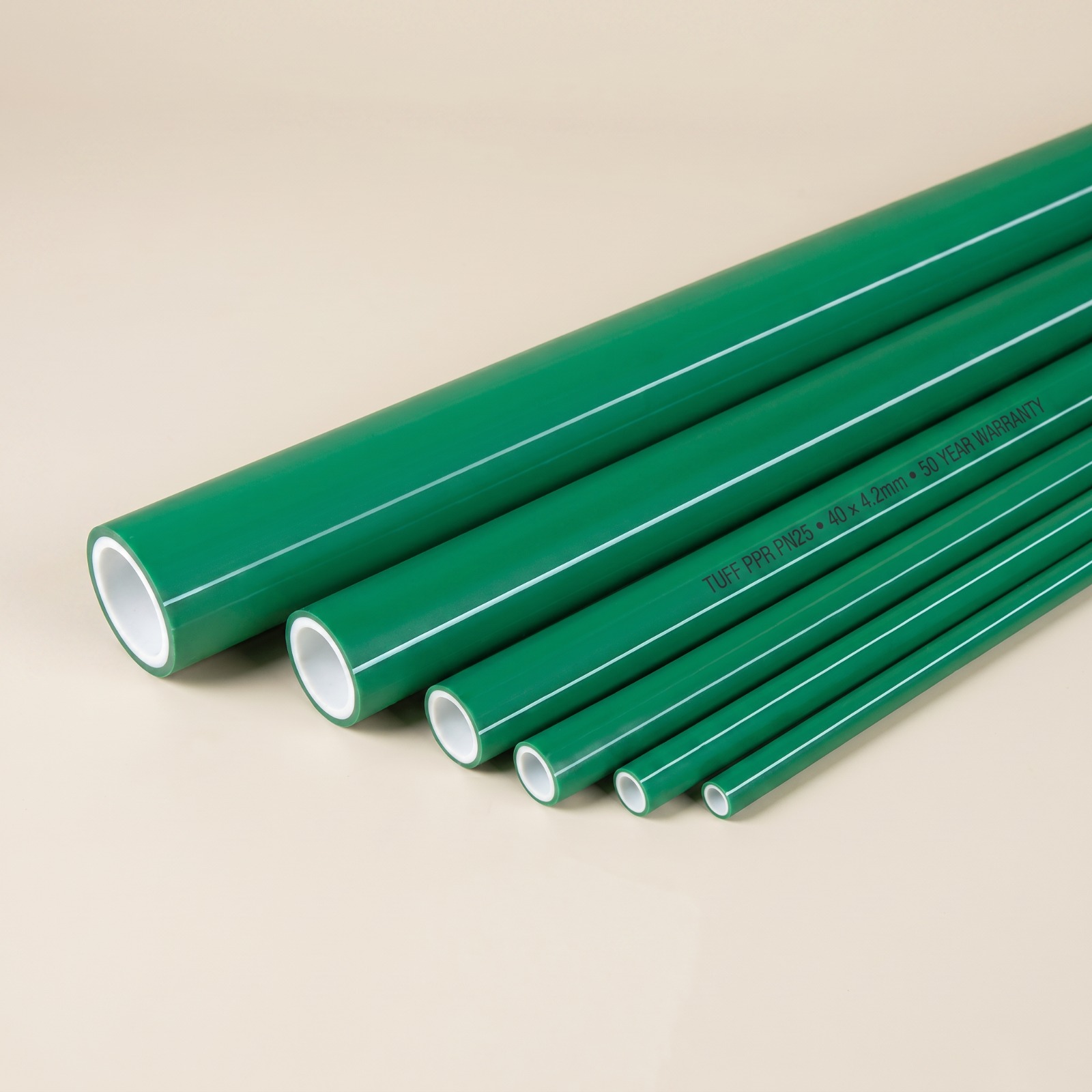
TUFF PN25 PPR Pipes are designed with a double layer construction to enhance performance and reliability.
Key features include:
- White antimicrobial inner layer designed to support hygienic water distribution.
- Durable green outer layer that provides strength and helps protect the pipe during handling and installation.
- Smooth internal surface to promote efficient water flow.
- Heat fusion compatibility for strong, leak-resistant joints.
These features combine the proven benefits of Polypropylene Random Copolymer with practical advantages for modern plumbing projects.
Designed as a Complete Plumbing System
Reliable plumbing depends on system compatibility.
TUFF offers a complete range of compatible products, including:
- TUFF PN25 PPR Pipes
- TUFF PPR Fittings
- TUFF Brass Ball Valves
- TUFF Fusion Welding Machines
- TUFF PPR Accessories
Using products designed to work together helps simplify installation, improve joint consistency, and support dependable long term system performance.
Built for Professional Applications
TUFF PN25 PPR plumbing systems are suitable for a wide range of projects, including:
- Residential homes
- Apartment developments
- Commercial buildings
- Hotels and hospitality facilities
- Hospitals and healthcare institutions
- Educational facilities
- Industrial water distribution systems
Whether the project is large or small, TUFF products are designed to meet the demands of professional plumbing installations.
Backed by Long-Term Confidence
Quality materials deserve long term assurance.
TUFF PN25 PPR Pipes and Fittings are backed by a 50-year warranty, reflecting confidence in their quality, durability, and long-term performance when installed and used in accordance with applicable guidelines.
Combined with technical support, installation guidance, and a commitment to quality, TUFF provides more than plumbing products it provides confidence throughout every stage of a project.
A Smarter Choice for Modern Plumbing
The quality of a plumbing system starts with the material and is strengthened by every component that follows.
By choosing TUFF PN25 PPR Pipes, you’re selecting a plumbing solution manufactured from high quality Polypropylene Random Copolymer, supported by compatible fittings and installation equipment, and designed to deliver reliable hot and cold water distribution for years to come.
Because lasting plumbing performance begins with quality materials and quality materials begin with TUFF.
Speak with a TUFF Plumbing Expert
Choosing the right plumbing material is one of the most important decisions in any construction or renovation project. Understanding what PPR pipes are made of provides valuable insight into why material quality influences durability, pressure performance, water quality, and long term reliability.
However, selecting the right products is only part of the process. Choosing the correct pressure rating, pipe size, fittings, and installation method also plays a critical role in building a dependable plumbing system.
Whether you’re a homeowner planning a renovation, a plumber preparing for an installation, a contractor managing multiple projects, or an engineer specifying plumbing materials, expert technical guidance can help ensure the right decisions are made from the start.
At TUFF Bathrooms, we combine premium plumbing products with professional support to help customers achieve reliable, long-lasting water distribution systems.
How We Can Help
Our team can assist you with:
- Selecting the appropriate PN25 PPR pipes for your project
- Choosing compatible PPR fittings and accessories
- Understanding pressure ratings and pipe sizes
- Recommending suitable fusion welding equipment
- Providing technical product information
- Helping you locate your nearest TUFF showroom or authorised distributor
Whether your project is residential, commercial, healthcare, hospitality, or industrial, our team is ready to provide practical guidance based on your project requirements.
Why Professionals Trust TUFF
Construction professionals choose TUFF because we provide more than plumbing products.
We offer:
- High quality PN25 PPR plumbing systems
- Complete compatible plumbing solutions
- Technical knowledge and installation guidance
- Reliable customer support
- Products designed for long term performance
- A 50-year warranty on PPR pipes and fittings
By combining premium materials with professional expertise, TUFF helps customers build plumbing systems with confidence.
Build Your Next Project on a Strong Foundation
The quality of a plumbing system begins with the material and is strengthened through careful product selection, professional installation, and ongoing technical support.
If you’re planning a new project or upgrading an existing plumbing system, our team is ready to help you select the right PPR solution for your application.
From product selection to installation support, TUFF Bathrooms is committed to helping you build plumbing systems that deliver reliable performance for years to come.
Choose Quality Materials. Build with Confidence.
The right plumbing system starts with the right material. By choosing TUFF PN25 PPR Pipes, you’re investing in high-quality Polypropylene Random Copolymer, compatible plumbing components, and expert support backed by years of industry experience.
Visit a TUFF showroom, request a product catalogue, or speak with one of our plumbing experts today and discover why professionals across Nigeria trust TUFF for dependable plumbing solutions.

Ready to Choose the Right PPR Plumbing System?
The quality of your plumbing system starts with the quality of its materials. Whether you’re building a new property, managing a commercial development, or upgrading an existing water distribution network, choosing the right PPR solution is essential for long term performance.
Speak with a TUFF Plumbing Expert today for professional guidance, request a product catalogue, or visit your nearest TUFF showroom to explore our complete range of PN25 PPR pipes, fittings, valves, and fusion welding equipment.
Build with confidence. Choose quality materials. Choose TUFF.
TUFF Bathrooms. Maximum Durability.